Age-verification laws now affect millions across the U.S., with platforms blocking non-compliant states.
Creators face heavy compliance burdens, financial pressure, and shrinking audiences.
Europe is following the same trend, from France’s AV rules to Italy’s 25% tax on online sex work.
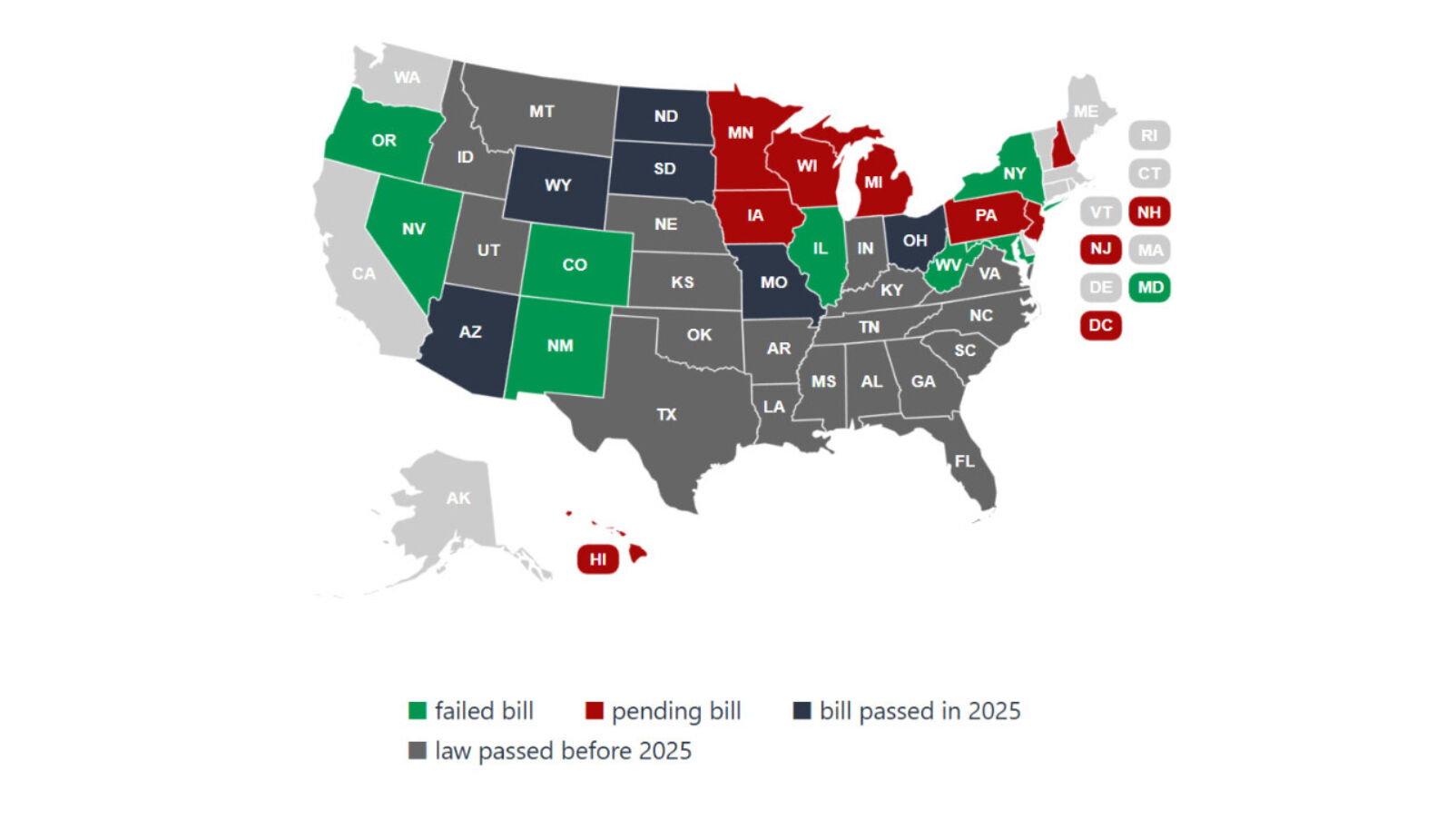
Since 2023, more than twenty U.S. states have introduced bills governing online adult content, and at least eight states including Louisiana, Utah, Arkansas, Mississippi, Virginia, North Carolina, Arizona, and Ohio, now have age-verification laws in effect.
This marks the most aggressive regulatory push the industry has seen since the early internet. The Free Speech Coalition has warned that the number of bills increases each quarter, signaling a long-term trend rather than isolated incidents.
A New Wave of Anti-Porn Legislation
Age Verification and Retroactive Consent: A Growing Compliance Crisis
Age-verification laws require every viewer to present government ID, and the impact is immediate. After Louisiana implemented its AV law in 2023, Pornhub reported an 80% drop in traffic from the state overnight, an evidence of how quickly user behavior changes when privacy feels compromised.
In North Carolina, the new HB 805 law went even further when it took effect on December 1, 2025. It requires platforms to collect written consent for every performer and every individual video, including older uploads. For creators with extensive catalogs, this can mean reorganizing and re-signing hundreds of files just to remain compliant. Platforms unable to verify full documentation face legal liability, prompting several to restrict traffic from the state altogether.
The Push to Restrict VPNs and Why Platforms Are Blocking States Instead
A new wave of bills is attempting something even more controversial: banning VPN access to adult sites. Wisconsin’s SB 130 would obligate platforms to detect and block VPN traffic entirely. The Electronic Frontier Foundation notes that roughly 39% of U.S. adults use VPNs at least occasionally, meaning millions of legitimate users would be affected.
Because detecting VPN usage is technically unreliable, platforms often respond in the only legally safe way: blocking access to the whole state.
That is why Pornhub and related sites currently block users in Utah, Virginia, Mississippi, and Texas. ManyVids recently restricted access in North Carolina the day HB 805 became active. Chaturbate, facing Alabama’s new 10% adult-content tax, has stopped verifying accounts that use Alabama IDs.
The Michigan Bill: A Glimpse Into a More Extreme Future
Michigan’s proposed “Anticorruption of Public Morals Act” illustrates how far some legislators want to take this movement. The bill would criminalize any depiction of transgender people, even in non-sexual media. Penalties include prison sentences of up to 20 years and fines exceeding $100,000, with harsher penalties for cases involving more than 100 pieces of content. It also requires ISPs to block access to any prohibited material and bans the use or promotion of VPNs or other circumvention tools.
While the bill is unlikely to pass in its current form, it signals a political willingness to tie adult content regulation to broader culture-war legislation.
Map of the age-verification bills in the U.S.
Financial Pressure to Weaponize These Laws
Adult platforms are not only battling legislation but also increasing pressure from financial institutions. In 2024, Chaturbate settled with the Federal Trade Commission for $675,000 (reduced from an initial $1.78 million) for failing to implement new age-verification measures within the expected timeframe. For banks and processors, this reinforced the perception that adult businesses carry significant compliance risk.
When a payment processor withdraws from a platform, creators feel it immediately: delays in payouts, loss of payment options, and stricter account reviews. For smaller platforms, the financial burden can be existential.
How These Laws Are Affecting Creators and Viewers
For creators, the consequences are already measurable. Traffic has dropped significantly in states under AV laws, some performers report declines of 20–40% during peak U.S. hours. North Carolina-based models face unexpected administrative workloads as they revisit years of content to meet retroactive consent rules.
In Alabama, a 10% adult-content tax makes the state increasingly unworkable for performers. Trans and gender-nonconforming creators face disproportionate harm because they are more likely to be targeted under ambiguous or identity-focused legislation.
These "age gates" remain a threat to the free speech and privacy rights of both adults and minors
For viewers, the online experience is becoming fractured: entire states lose access to major adult platforms, VPNs no longer guarantee privacy, and some sites now require ID verification even for browsing previews.
An International Trend, Not Just an American One
The U.S. isn’t alone. Across Europe, several countries are moving toward stricter controls on adult content.
France now requires porn sites to use government-approved age-verification systems, and in June 2025 major platforms like Pornhub temporarily blocked French users in response. Italy introduced mandatory age-verification in late 2025 and added a 25% “ethical tax” on online sex work. Other countries including Germany, Spain, Ireland, and the UK are developing similar frameworks under the EU’s push for continent-wide age-assurance standards.
Forcing you to repeatedly provide sensitive personal information creates an unacceptable security risk that we refuse to impose on our users.
Together, these measures suggest a broader international shift toward tighter regulation of adult content, not just an American trend.
Conclusion: A Critical Moment for the Future of Adult Content
The modern “war on porn” does not resemble past censorship efforts. Instead of banning content outright, lawmakers are targeting the infrastructure that makes adult content possible: ID verification systems, payment processors, VPNs, consent documentation, and platform liability. These pressure points affect creators and viewers in ways that are deeper and more lasting than simple content restrictions.
As the Electronic Frontier Foundation warns, the danger extends beyond the adult industry. Policies designed to regulate porn have historically become templates for regulating entire sections of the internet.